Sunday, 22 June 2025

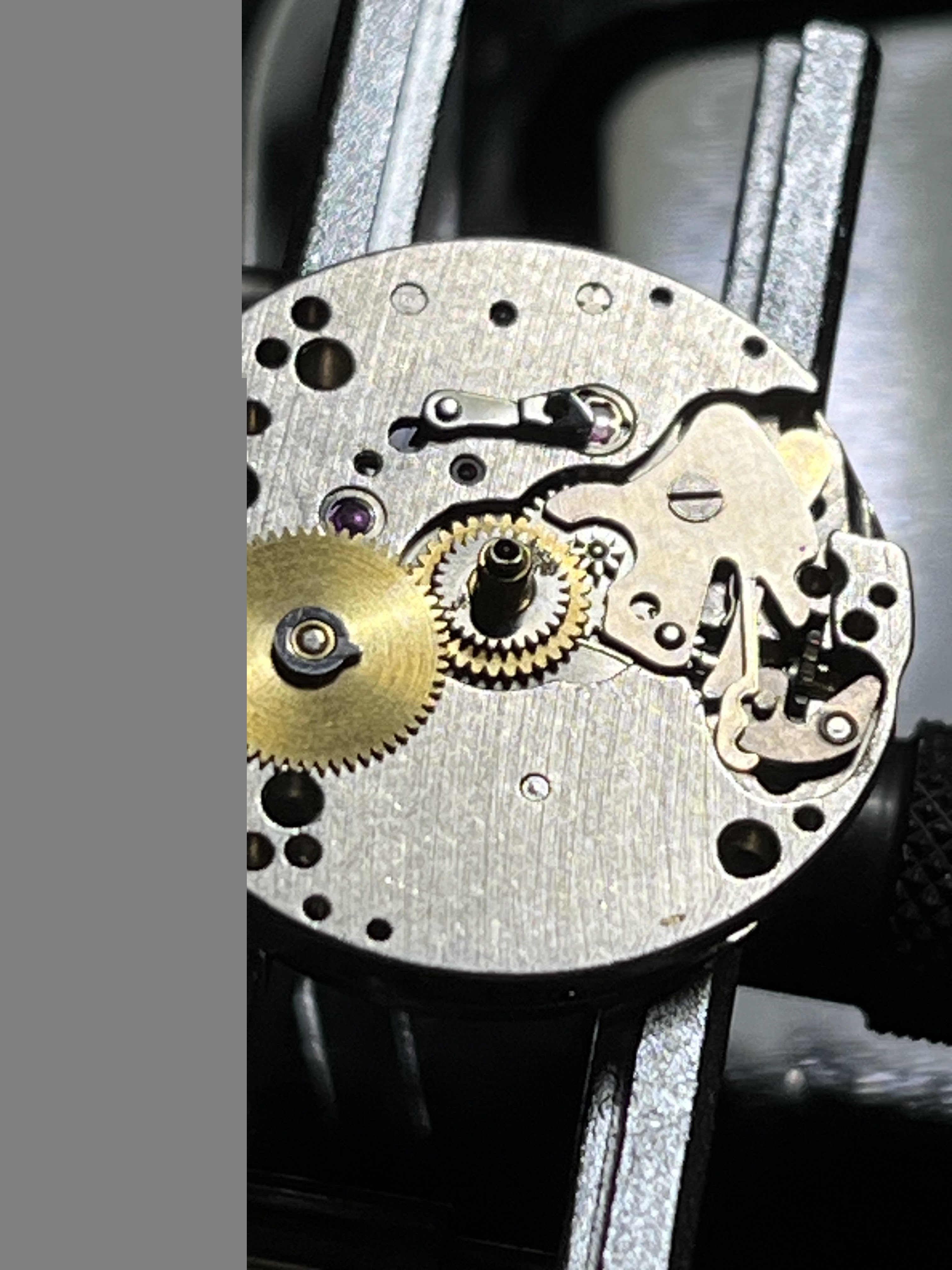
Iaxa FHF 96-4, late 1960s

 A good workhorse from an obscure, prolific Belgian brand that was mostly active in late 1960s to mid 1970s, sold through stores in Belgium and the western part of France. No literature remains about the brand, no marketing material or newspaper info.

Jacques Meyer registered Chronomètre Iaxa in 1903 and was based in La Chaux-de-Fonds, Switzerland, in December 1913 the brand was transferred to Les Fils de Jacques Meyer, in Brussels. The Iaxa brand was registered in Brussels in August 1944. Little more is known of this Belgian brand other than a Jean Meyer was "Director General" from 1965 to 2006. It is quite likely that Iaxa actually ceased trading towards the end of the 20th century. 

Movement just needed a service and a new setting lever spring and works incredibly well for the age.


Before servicing


Position Rate Amplitude Beat Error
DU -16 308 1.5
DD -22 319 1.7
CR -37 245 1.8
CD -39 266 1.8
CU -39 266 1.8


Delta 23

Mean -30.6 280.8 1.72

And after 


Position Rate Amplitude Beat Error
DU 5 324 0
DD 0 314 0.2
CR 0 254 0.5
CD -1 256 0.4
CU 1 249 0.1


Delta 6

Mean 1 279.4 0.24

Show off opportunity: Fero EB 1333 pin pallet escapement, a movement from late 1950s hell


This one kinda ran, but only occasionally. Would randomly stop.

It uses a pin-pallet escapement (Roskopf) so the 17 jewels on dial, while true, is extremely misleading. It is a cheaply made disposable piece of crap that needed a huge amount of work.

The mainspring, regulator pallet fork needed replacing.

Broke the escape wheel top pivot by mistake as the lower cap jewel wasn't installed when installing the train bridge. Lesson learned. 

Three cap jewels needed replacing.


The hairspring was out of round and out of flat. Hairspring work has to be the thoughest part of servicing watches. took a long time to get right.

Before. Who knows what happened here, but something did happen.


And after.

The third wheel also had rust and pitting between the pinion leaves. So dialux and a wooden skewer were used.


 Even polished the setting rocking bar and dial-side cap jewel settings, because why not.


All this work and effort, for what? The timegrapher results are sad.


Cased and left to run for 24 hours then will re-check. But this one got the royal treatment that would have been really expensive and a task no professional would probably accept.


 Then, touched the regulator and dial up stopped working. Too much endshake. Oh well, leaving well enough alone for now, I'm fed up of this movement. I'll adjust the endshake when I get the Horia tool.

Update: the balance top cape jewel became loose. Closed the hole again, re-inserted the jewel and will let it run for a day or two but the results are really promising. I managed to get a low quality movement that's almost 70 years old to work better than it did when it came out of the factory. This is the sign that I've gotten simple wrist watch servicing and basic repairs, jewel replacements and ahrispring work, down. I have a couple more watches that need servicing and after those I'll be moving on to tougher repairs with an inital focus on bushing worn pivot holes.


The timegrapher results after fixing the loose cap jewels are impressive, for such a bad escapement. I'm proud of this one.

Position   Rate Amplitude Beat Error
DU 61 273 0
DD 63 277 0
CL -32 228 0.1
CD -1 229 0.3
CU -19 232 0.2


Delta 95 49 0.3
Mean 2.2 193.2 0.12


Thursday, 19 June 2025

Royce FEF 6686, ca 1985

 First non-practice watch I worked on. Really small compared to my practice movements. Pallet fork had a broken pivot and the setting lever spring was half broken so got a donor for both the part and practice.

Unfortunately the donor also had a broken setting lever spring so a NOS one from CousinsUK had to be purchased. Not a big deal.


Before

And after


Thursday, 5 June 2025

Stowa Durowe 72 (1964 to 1970?)


My mother had this old, beat up watch that barely worked and gave it to me to take a look and check the battery. Opened it up and found this tiny, tiny movement that seemed to be trying it's absolute best to work. In my naiviety I told her I can try to service it and restore it. "How hard can it be, just clean, oil and see what happens" I said to myself.

Little did I know how tiny these 5 1/2''' movements really were. Smallest I had worked on was 8 3/4''' and that was already stretching it.

Well...turned out pretty well and I'm so proud of it I just had to go on the internet and write about it.

Everything went surprisingly smoothly. The scale of the parts wasn't THAT big of a deal until it came to installing the setting lever. That setting lever can go burn in hell. I didn't mangle any screws any worse than they were, didn't drop or lose any parts (there was a mishap where I moved the pallet fork while moving a jar on my table and that was terrifying but it was right by the jar). To me this means that I've made huge strides since starting ten months ago.

I have no idea how watchmakers used to service these without the use of microscopes but I gained a huge amount of respect for those who did, on a regular basis, especially seeing how this size of movement was very common in the 50s to 70s. I've learned so much but this, to me, seems to be at the absolute limit of human dexterity.

Before: looks beaten up, old and ugly.

IMG_1496.jpeg

Case cleanup was really easy. I've used Selvyt cloths (JC and SR) on another gold plated watch and it went really well, as it did on this. On close inspection you can tell that it's lived a long life but from a distance it looks new and shiny.

IMG_1504.jpeg

It ran, but the state of affairs was pretty sad. I used 52 deg lift angle because I didn't know what the movement was yet, turns out that the LA is 56 (supposedly).

IMG_1525.jpeg

Dial down didn't fare any better, but at least the beat error was on point. This gave me hope.

IMG_1528.jpeg

The fourth wheel pivot can be seen here in a plate under the escape wheel. Crazy stuff.

IMG_1529.jpeg

Just getting the movement to sit still in the holder was a challenge, being careful and diligent helped. I really like the satin finish on the movement, had never seen it before but I think I prefer it over overly shiny. It just looks neat, refined and that this movement means business.

The shock spring is also interesting here. Unlike Inca, the spring doesn't hinge but just slides out. Easy to ping I guess but at least you don't have to take the whole setting out to replace it. And really easy to put back in with a jewel picker/rodico, far easier than Inca.


Fourth wheel's "shelf" can be seen here.

IMG_1535.jpeg

Someone oild the pallet fork a long time ago. Hadn't seen it before but glad Kalle mentions it regulary, I wouldn't have thought to check otherwise. But I found one in the wild, that's pretty cool.

IMG_1540.jpeg

Just comparing sizing, because I'm a guy.

IMG_1543.jpeg

And after completing the service, right after winding and initial rough regulation. I know that I first need to let it settle for at least 24 hours, wind it, leave it for a few more and then regulate, and I do that, but I can never stop myself for regulating it before putting the hour wheel and dial on.

IMG_1546.jpeg

Dial foot screw. One of the dial feet is slightly bent but I know enough to leave it alone.

IMG_1550.jpeg

Cased. She chose a red strap and to be honest it looks really nice. For some reason my phone makes the red look way more bright than it actally is; it is more of a bright strawberry red.

IMG_1555.jpeg

About an hour after casing, with the appropriate LA. I didn't even change the mainspring so I'm really surprised at the amplitude. I hope it isn't too much but I suspect that 56 is just wrong. I didn't check myself with the balance, and maybe I should, but ah well.

IMG_1557.jpeg

The rate variation is due to a fail in the wiggle wiggle test. Barrel needed hammer time but the the third wheel and pallet pivots have quite some wiggle in them. I have a jacot lathe, that I got for really cheap (89 euros) that is in decent condition but I never used it and I wasn't going to try it here first. The hairspring is also ever-so-slightly tilted, I just think that the stud needs to be moved up a little but I'm scared to touch it and I think in this case I can leave well enough alone. I've had a few mishaps with hairsprings and although I managed to recover from them they were much larger.

Overall I'm really happy that I managed to get service it and get it to run so well without screwing anything up. I'm pretty proud of this one. A pro might scoff and that this isn't really professional work because of the rate fluctuation and that's understandable, I'm not at a first-rate result level yet but I really hope to get there someday.

Elgin 303 - 7j 1924 12s pocket watch update: it lives!

 I had been dreading this movement for so long because it needed rebushing of BOTH escape wheel pivot holes. Started back in August 2025 htt...